

The Dragon Book

Caitlyn loves dragon stories, and today she can barely wait for the last bell to ring. The moment it does, she hurries out of her sixth-grade classroom, waves to a few friends, and heads for the little lending library in her neighborhood.

Last night, she spotted a flying dragon on the cover of one of its books. She wanted to take it then, but she hadn’t brought a book to exchange. Today, she’s ready.

She reaches into the middle compartment of her backpack to make sure her book is still there. It is. She smiles—and stops.

Mr. Bellows is standing at the little library.

Caitlyn darts behind a row of bushes and crouches. She lifts her head just high enough to see him open the glass door and pull out one book. Then another.

Please don’t take my dragon book.

By the time he closes the door, six books are in his bag. He hasn’t put a single one back.

Where are the books he’s supposed to trade?

Mr. Bellows heads down the sidewalk. Caitlyn rises from behind the bushes—and nearly screams when Jeremy lands beside her.

“Why are you spying on Mr. Bellows?” he asks.

“He just took six books.”

“As long as he swapped them, who cares?”

“He didn’t. His bag was empty when he got here.”

“Then let’s ask him about it.”

Jeremy starts to stand. Caitlyn grabs his sleeve and pulls him down.

“I don’t want to make a thief angry,” she whispers.

“A thief? Cait, he’s our neighbor. I’m going to ask him a question.”

“You’ll make a scene.”

“What scene?”

Caitlyn glances down the sidewalk. “Let’s wait until he turns the corner. Maybe he left a note explaining why he borrowed them.”

Jeremy settles back on his heels. “Okay. That’s worth checking.”

They watch Mr. Bellows turn the corner, then hurry to the little library. Caitlyn opens the glass door and searches every shelf.

No note.

“He took my dragon book,” she says, her voice catching. “And he left nothing for the six books he took.”

Jeremy peers inside. “That’s almost half the library.”

“We need to tell Emma’s mom. She takes care of it.”

“First, let’s find out what’s going on.”

“It’s obvious what’s going on.”

“Then asking him won’t change anything.”

Jeremy starts toward the corner. Caitlyn stares after him for a moment, tightens the straps of her backpack, and runs to catch up.


They spot Mr. Bellows crossing the park. He continues across the street and walks around the back of the retirement community.

Caitlyn motions for Jeremy to keep quiet. Together, they circle the building and slip behind a cluster of evergreens.

Beyond the trees, six older women are gathered around a patio table. Mr. Bellows lays his books on it. Each woman adds a book of her own.

“Okay, ladies,” he says. “You have twelve books to choose from today. I’ll return whichever six are left to the neighborhood library.”

Jeremy looks at Caitlyn.

“What?” she whispers. “How was I supposed to know?”

“He’s giving them more choices. They can pick from twelve books instead of six.”

“Yeah, I can count.” Caitlyn watches the women turn the books over, reading the covers. “But somebody could be standing at the library right now, hoping to find that dragon story.”

Jeremy leans against a tree. “There’s more than one way to share a story.”

Caitlyn looks at him. Then at the women. Then at the dragon book on the table.

“Oh,” she says.

She steps out from behind the evergreens.

“Mr. Bellows?”

He turns. “Caitlyn! Hello.”

She swallows. “Before everyone picks a book, would you like me to read the first chapter of that one?”

She points to the dragon on the cover.

The women pull their chairs closer. Mr. Bellows hands Caitlyn the book, and she opens it.

“Dark clouds swirled above the stone castle. Along its walls, torches burned in black iron sconces. The Watchers hurried to their posts, searching the sky for the dragon hidden somewhere in the clouds…”

By the end of the first chapter, no one wants her to stop. Caitlyn reads a second. As the sun sinks below the treeline, the women thank her and begin choosing their books.

Caitlyn makes her way around the table, hugging each woman. She gives the dragon book back to Mr. Bellows.

“You made everyone’s day,” he tells her.

Caitlyn glances toward the women. “I’m glad you bring the library to them.”

“Well, I’d better return these six before supper.” He gathers the remaining books into a stack.

“I can do that. I live next door to the little library.”

Mr. Bellows hands them to her and heads inside. Jeremy joins Caitlyn as the women carry their new books into the building.

“You’re a pretty good storyteller,” he says. “No wonder your imagination got so dramatic.”

Caitlyn jabs him lightly in the ribs.

“Ow! Be nice, and I’ll carry those books for you.”

She drops the stack into his arms, then takes the dragon book from the top.

“I’ll carry this one.”

Together, they cross the street and cut through the park, bringing all six books back to the little library.

Copyright © 2026 by CJ Powers
5 Human Skills That Become More Valuable as AI Use Increases

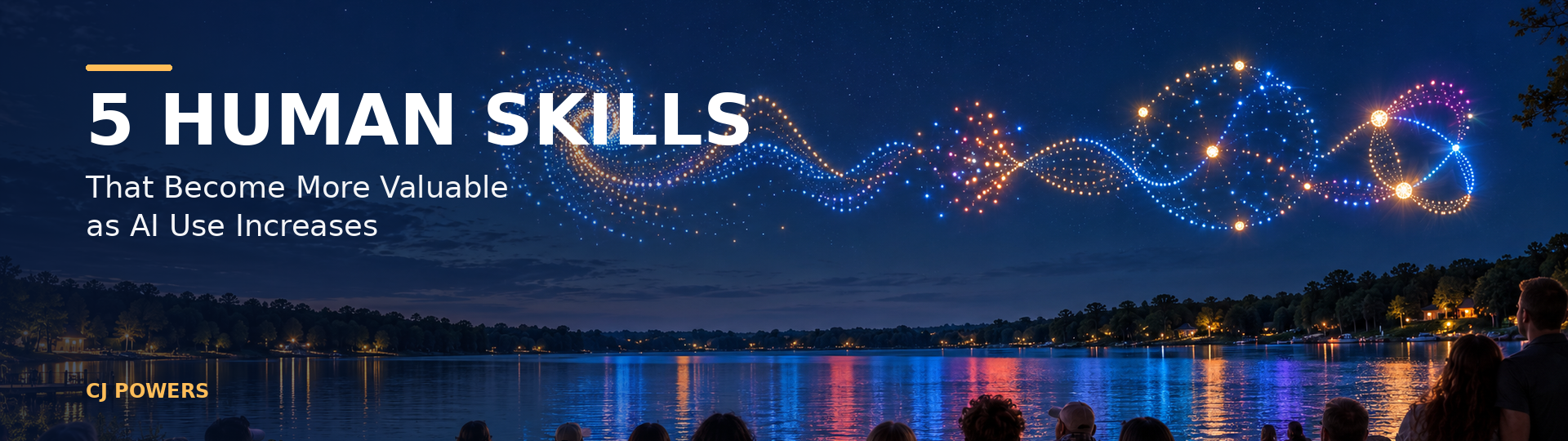
People watching a drone light show over a lake with the words 5 Human Skills That Become More Valuable as AI Use Increases

Our Fourth of July fireworks were rained out and rescheduled for Labor Day weekend. The celebration included an incredible drone display moving over the lake. Watching the drones glide between one another while changing colors and forming three-dimensional images was mesmerizing.

As I watched, I couldn’t help but wonder whether AI would eventually replace the people who created shows like this. Then it dawned on me: The entire experience began with human ingenuity.

The human contribution was strategic, creative, and artistic. The technology was tactical, precise, and perfectly repeatable. Combining human imagination with machine precision created an unforgettable night.

Some people are afraid that AI will eventually take over everything we do. But that night, I realized that people become more valuable when they focus on the uniquely human contributions—not the repetitive, tactical ones.

When I was a kid, my mom wasn’t worried that the invention of the dishwasher might eliminate her nightly job of cleaning the dishes. She embraced the new technology and spent more time with our family.

Did she feel less valuable because she stopped washing the dishes?

Of course not. The dishwasher handled the repetitive task so she could spend more time on what mattered.

AI may reduce the value of repetitive or tactical tasks, but it will increase the value of the human skills needed to guide those tasks.

I believe learning to lead AI with the following five human skills will increase our value and create more opportunities for our future.

1. Creativity: Imagine What Could Be

AI can generate endless possibilities, but human creativity gives those possibilities direction, meaning, and purpose.

You can ask AI for 100 ideas and receive them in seconds, but more ideas do not automatically lead to a better idea. Someone still has to recognize an unmet need, ask an unexpected question, challenge an old assumption, or imagine an outcome that does not yet exist.

Creativity is more than producing content. It is seeing possibilities and connecting them to something that matters. We can do this through troubleshooting, combining unexpected ideas, or using sheer imagination.

Our experiences, frustrations, hopes, relationships, and sense of purpose influence what we create. AI can help us explore an idea, expand it, or examine it from different perspectives. But a human being must still decide what is worth creating and why it should exist.

As AI makes production easier, imagination with purpose will become more valuable.

2. Discernment: Decide What Should Be

AI can offer answers in seconds, but we still need humans to decide which ideas are true, useful, ethical, and worth pursuing.

AI does not remove the need to think. It increases it.

The faster we can generate information, recommendations, strategies, and content, the more important it becomes to evaluate them carefully. We must determine whether the information is accurate, whether the recommendation fits the situation, and whether the proposed action moves us toward our purpose.

We also need to consider who could benefit from a decision and who could be harmed by it. Something should not be done simply because technology has made it possible.

The question is no longer whether AI can produce an answer. The question is whether we have the wisdom to know what to do with it.

Discernment turns possibility into direction.

3. Communication: Make the Idea Clear

A powerful idea cannot create change until someone clarifies what matters, simplifies what is complex, and amplifies the right message.

AI allows us to produce more words than ever before, but that does not mean people have more time or attention to give us. Most are already overwhelmed by emails, messages, meetings, reports, posts, and presentations.

Adding more content to the noise is not the same as communicating.

Strong communicators help people understand what matters. They clarify their intention, simplify the message without weakening it, and adapt it for the people who need to hear it. They also confirm that the message was understood.

AI can help us organize, draft, and refine our words. Clear communication, however, still requires a human being who understands the purpose, the audience, and the desired outcome.

Clarity will become a competitive advantage in our noisy, AI-generated world.

4. Connection: Give People a Reason to Care

AI can simulate attention and empathy, but only people can build the trust that makes someone feel seen, heard, and valued.

Technology can help us remember a birthday, prepare for a conversation, or respond more quickly. It can recognize patterns in what someone says and even produce words that sound thoughtful and compassionate.

But words alone do not create a relationship.

Connection requires presence. It grows when we listen to understand, relate through shared experiences, and demonstrate that another person matters to us.

People do not want to feel processed by a system. They want to know that someone genuinely cares about them.

We should use AI to remove the clutter surrounding relationships, not to avoid the responsibility of having them.

As AI becomes more common, authentic human connection will become easier to recognize and harder to replace.

5. Collaboration: Turn the Idea Into Action

AI can assist every person on a team, but it still takes humans to align around a purpose, act together, and achieve something none of them could accomplish alone.

Equipping each team member with an AI assistant does not automatically make the team stronger. People can use excellent tools and still move in different directions, generate polished plans without building agreement, or work faster without working together.

Collaboration requires people to align around what they are trying to accomplish. They must understand their roles, take action, communicate through challenges, and remain accountable to one another.

AI can support that work by organizing information, identifying patterns, documenting decisions, and automating repetitive processes. But technology cannot create unity for us.

People must create the unity.

The greatest accomplishments will not come from technology working alone. They will come from people who know how to combine human strengths with technological capabilities.

Becoming More Human

These five skills create a natural progression. We use creativity to imagine what could be and discernment to decide what should be.

We use communication to make the idea clear and connection to give people a reason to care. Then we use collaboration to turn the idea into action.

AI can support every part of that process, but it should remain an assistant. It should not become the source of our purpose, judgment, relationships, or responsibility.

The goal is to develop the qualities that allow us to use powerful technology wisely. Instead of asking only what AI can do, we must also ask what kind of people we need to become.

While AI may help us do more, these five skills help us become more.

When we learn to guide AI rather than surrender our judgment to it, we can use its power to pursue the goals we choose—not the ones technology chooses for us.

About CJ Powers

CJ Powers is a filmmaker, author, communication strategist, executive speaking coach, and AI consultant. He helps leaders use AI effectively while strengthening the human skills technology cannot replace.

Copyright © 2026 by CJ Powers

Why My Phone Hides Everything but Fitness Apps at the Gym

How AI helped me create an automatic Gym Focus—and reclaim my attention.

This morning, I got into my SUV, and my navigation app offered a route to the gym. It knew my habits.

When I pulled into the gym parking lot, my phone notified me that it was time to focus on exercising. Nearly every app page on my iPhone disappeared, leaving me with only one page of exercise apps.

When I finished my workout and left the parking lot, my phone revealed all my app pages. My focused gym time had ended.

I don’t need to remember to turn anything on. I don’t have to reorganize my phone before every workout. The change happens automatically because I used AI to help me build a location-triggered Gym Focus.

But the most important part of this story isn’t what AI did.

It’s the decision I made before asking AI to do anything.

The Observation

Working out is a priority for me—but priorities need support from our environment.

I’ve noticed that our phones treat every part of our lives as if it belongs on the same screen.

Work apps sit next to entertainment apps. Fitness apps compete with email, social media, news, shopping, and games. Every time we unlock our phones, hundreds of options ask for our attention.

And unless we intervene, everything is presented with roughly the same level of importance.

While many of my apps play an important role at some point in my life, most aren’t useful at every moment.

When I enter the gym, I don’t need my entire digital life displayed in front of me. Nor do I want to be overwhelmed by the vast number of apps on my phone. I only need a small set of tools to help me exercise.

That got me thinking. What if my phone could automatically adjust its priorities when mine changed?

The Real Problem

The problem surfaced at a pool party I attended yesterday. One guy complained about the number of minutes he spent searching for the right app. He said he went through this search a few dozen times each day.

The problem: every app was being given equal access to his attention.

We often blame ourselves for becoming distracted, but our phones are designed to keep presenting us with choices. Even if we open the phone with a clear purpose, a notification, an email badge, a news alert, or a familiar social-media icon can lead us somewhere else.

At the gym, that could mean interrupting a workout to check something that could have waited until I finished.

I didn’t need more discipline. I didn’t need to go without certain apps. I needed a better environment.

The Investigation

I looked into Apple’s Focus feature, which can do much more than silence notifications. It can also determine which Home Screen pages appear while a particular Focus is active.

A Focus can be scheduled to turn on at a specific time, when a certain app opens, or when you arrive at a specific location. Apple also allows related apps and widgets to be organized on a dedicated Home Screen page. Apple explains the Focus scheduling options here and the page-customization concept in its Home Screen guide.

The capability already existed. I simply didn’t know how to turn it into the experience I wanted.

So I asked AI for help.

AI had previously given me step-by-step instructions for building a Shortcut. On another project, it even wrote an AppleScript for me. For my gym setup, I explained the outcome I wanted and used AI to walk me through the necessary steps.

This is one of the most practical ways to use AI: not merely to provide an answer, but to translate an intention into a workable process.

The Framework: Group, Focus, and Trigger

AI becomes far more useful when we can clearly explain what we want or need. Using the example of my phone’s Gym Focus, I created three decision points to guide what I provide to AI:

  • Group: Which apps belong together for a particular activity?
  • Focus: Which app pages should appear—and which should disappear?
  • Trigger: What event should activate and deactivate that environment?

For my gym setup, the answers were simple:

  • My fitness apps belonged together on one page.
  • That page should be the only one visible during a workout.
  • Entering the gym parking lot should activate the Focus.
  • Leaving the parking lot should return the phone to normal.

Once I had made those human decisions, AI could help me handle the technical setup.

The Story

The real test came the next day when I drove to the gym, especially since I had forgotten that I had set up the automation.

I entered the parking lot, and my Gym Focus activated. The regular pages on my phone disappeared, leaving the page I had created for fitness.

My phone hadn’t become less powerful. It had become more appropriate for the moment.

After my workout, I got into the car and headed home. Once I left the location, the Gym Focus turned off, and all my regular app pages returned.

Nothing had been permanently deleted or rearranged. My phone had simply changed environments with me. And just in case, I had a button to override my automation if necessary.

The Gym Focus is a small automation, but it solves a very human problem: the difficulty of protecting our attention. You can bet I started thinking about other priorities that might need the same kind of automated protection.

The Practical AI Step

You, too, can use AI to build systems that protect your priorities. Start by writing down the different roles your phone plays in your life.

You might create groups such as:

  • Fitness
  • Work
  • Writing
  • Family time
  • Travel
  • Church or personal reflection
  • Evening relaxation

Next, decide which apps belong together on each activity page.

Then ask AI something like:

Depending on the task and the access you give it, AI may be able to help create part of the automation. In other situations, it will serve as a patient technical guide while you build it.

Either way, review the instructions before making changes and test the automation in a low-risk situation.

The Human Takeaway

AI didn’t decide that exercise mattered to me.

It didn’t decide which apps supported that goal or which distractions interfered with it. It didn’t decide that entering the gym parking lot should mark the transition into workout time.

I made those decisions.

AI helped translate them into a system.

That is the kind of relationship we should be building with technology: humans determine the priorities; AI helps remove the friction.

Your Challenge

Look at the apps on your phone and ask:

Which apps naturally belong together—and during which parts of my day should the other apps disappear?

Create one dedicated page. Choose one Focus. Select one conditional trigger, such as arriving at a location, opening an app, or reaching a certain time.

Then ask AI to help you build it. Don’t use AI simply to help you do more.

Use it to help you focus on what matters.

Copyright © 2026 by CJ Powers